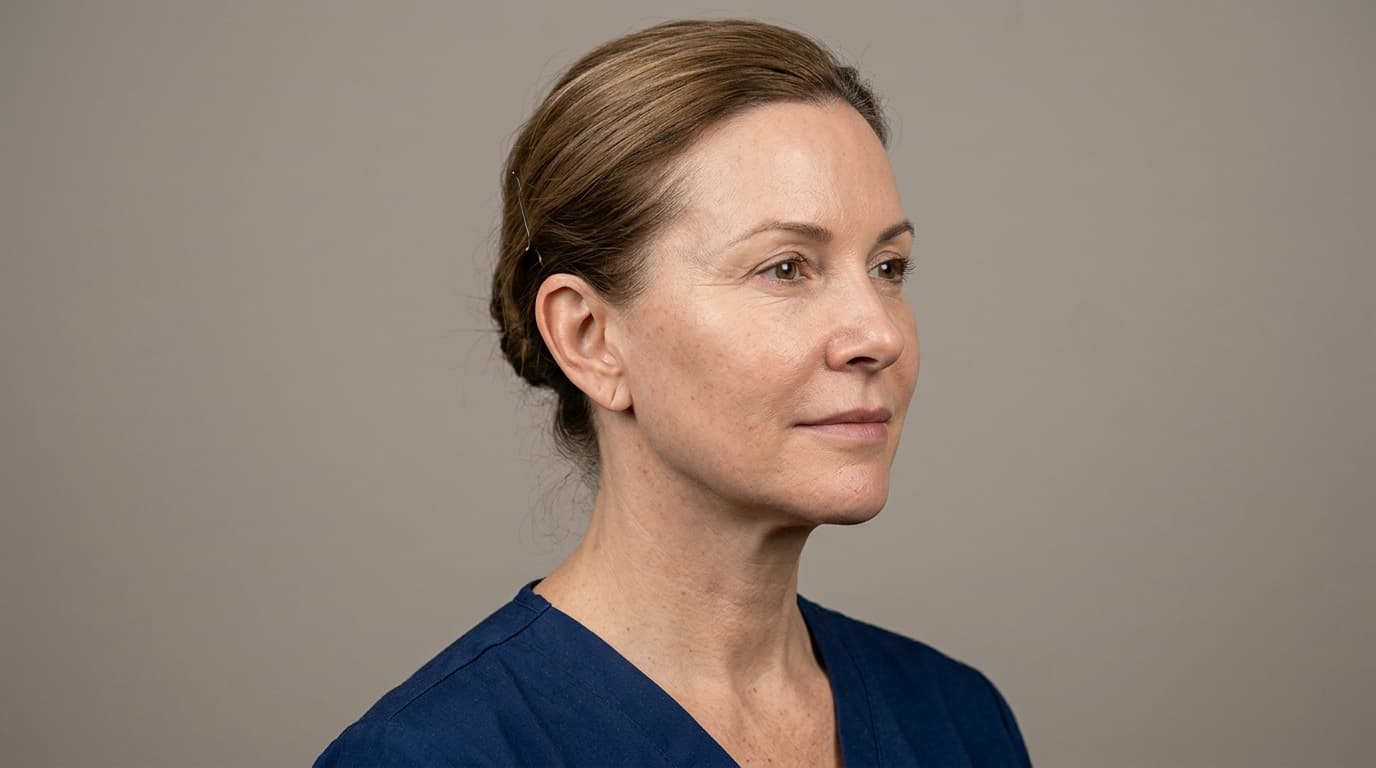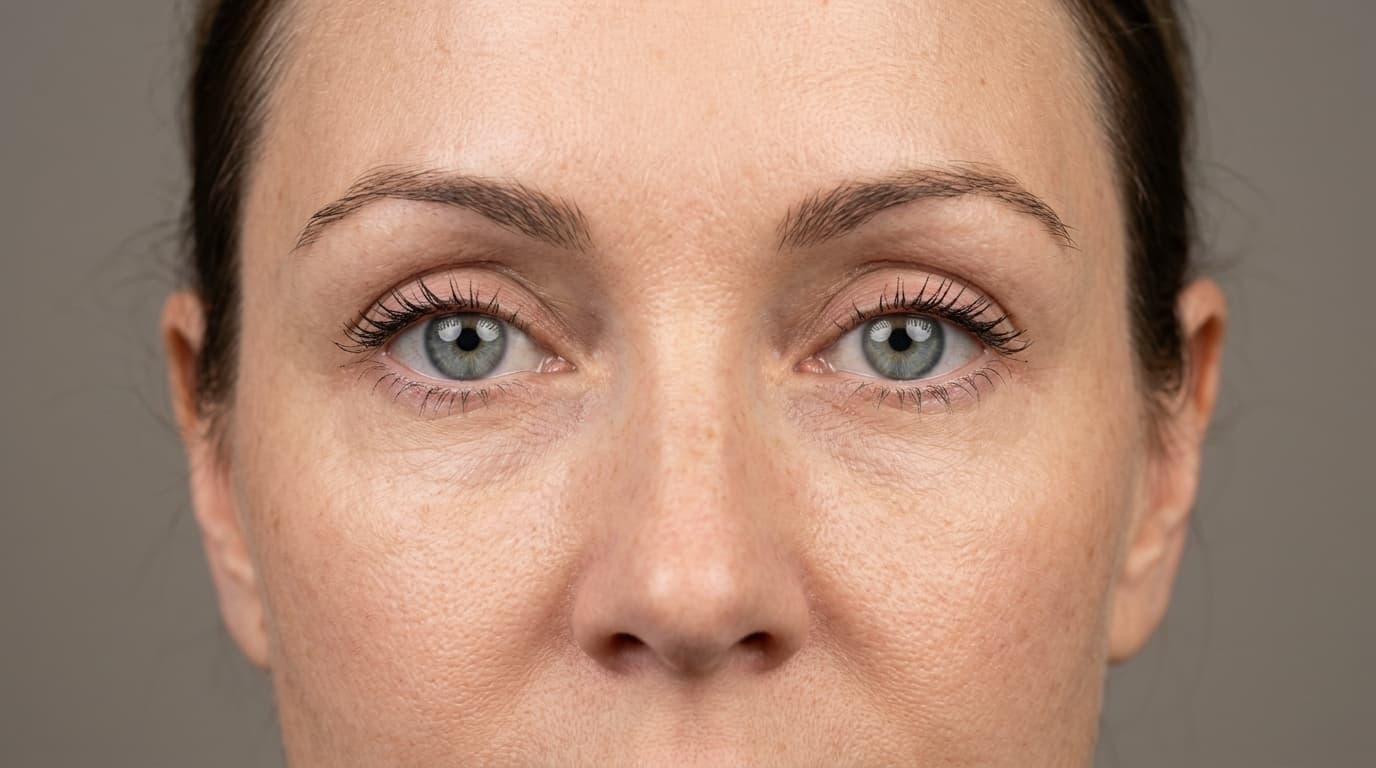
The eye area carries the thinnest facial skin and the most-read expression. Patients say ‘I look tired’; the surgeon separately measures dermatochalasis, retro-orbital fat herniation, levator function and brow position. The core sentence on our blepharoplasty page comes from here: not removing excess, but restoring anatomical balance.
Upper lid: skin, muscle, aponeurosis
Upper-lid heaviness is often a mix of excess skin (dermatochalasis) and levator weakness (ptosis). If only skin is taken and the aponeurosis ignored, the lid margin stays low. If the upper visual field is narrowed, the operation is functional, not merely aesthetic. The incision is hidden in the natural tarsal crease.
Brow descent makes upper-lid skin look ‘redundant’. Aggressive skin excision without seeing the brow can make closure difficult. In older patients a limited brow peaking through the same incision, or a separate brow lift / temporal lift, is discussed. A lateral-brow illusion with botulinum does not replace surgical ptosis.
Lower lid: bag, groove, support
The aim is not to ‘empty’ the bag. Over-resection of fat leaves a skeletonised, hollow gaze. Fat repositioning redistributes fat into the tear trough and softens the lid–cheek junction. If there is no skin excess, a transconjunctival (inside-the-lid) approach leaves no external scar. When skin and septum are lax, a subciliary incision is hidden at the lash line; lateral canthal support (canthopexy) is added to reduce ectropion risk.
HA filler in the tear trough can increase Tyndall and oedema when malar bags and septal herniation are present. A surgical candidate should not be ‘managed’ with filler.
The day of surgery and recovery
Local anaesthesia with sedation is enough for most isolated lid cases; general anaesthesia may be preferred in combined facial plans. Time is typically 45–90 minutes by scope.
- First 48 hours: intermittent cold, head up, drop protocol
- Days 5–7: suture removal (technique-dependent)
- Days 10–14: light makeup and most desk work
- Contact lenses usually after 10–14 days
- Intense sport at 3–4 weeks
Bruising and swelling are expected; permanent vision loss is not an expected outcome. Temporary blur and dryness are commonly described.
Risks, honestly
Asymmetry, dry eye, rare lower-lid retraction, hypertrophic scar. Preserving support and conservative excision reduce these risks. In men, a masculine crease and brow position are planned separately.
In short
Blepharoplasty is not a skin operation that ‘opens the eyes’; it is surgery of the lid–brow–cheek unit. A ‘skin-only’ plan is incomplete if brow, levator and lower-lid support are not discussed.